Three of the Most Common Anti-Wrinkle Systems for Web Converting

Nip Type (each edge of the web) Anti-Wrinkle Roller System
Description:
Nip type anti-wrinkle rollers are normally short face rollers (less than 12” face) and small diameter (less than 3” diameter). These rollers are supplied in a left and right hand set. Each set consists of 2 rollers pre-loaded so each roller face is pressed together; these roller faces must be parallel with each other. Each roller set is very similar in design to other nip rollers used in converting (such as drive nips). One of the rollers in each set must be rubber covered (for traction); sometimes both rollers in the set are rubber covered.
Theory of operation:
The left and right side nip sets are mounted to the machine frame and each edge of the web is fed through the nip rollers. The left and right side nip roller sets are then angled away from each other, facing in the down stream direction. Because of the web handling principle, that a web will seek to align itself perpendicular to a roller, in its entry span to that roller, each web edge will seek to be perpendicular to each nip roller set. This type of anti-wrinkle system is extremely aggressive and will eliminate more web wrinkles, more aggressively than any other type of anti-wrinkle system. Anti-wrinkle aggression can be adjusted, simply by adjusting the angle of each nip set

Nip Type Anti-Wrinkle System. Aggressive, Adjustable and Priced Right!
This type of anti-wrinkle system has no wrap angle. Because the web is not supported across its full width, the material must be fed straight in and out of this anti-wrinkle roller system assembly.

How Nip Type Anti-Wrinkle System Works.
Main advantages:
- This type of anti-wrinkle system is the most aggressive.
- Simplicity of design makes this type of anti-wrinkle system easy to maintain.
- The amount of anti-wrinkle aggression is easily adjustable, by changing the angle of each nip set independently of each other.
Main disadvantage:
- Because this anti-wrinkle system does not support the web across its full width, it may mark or distort foils. Typically, this anti-wrinkle system is not used with foil webs.
Bowed rollers
Description:
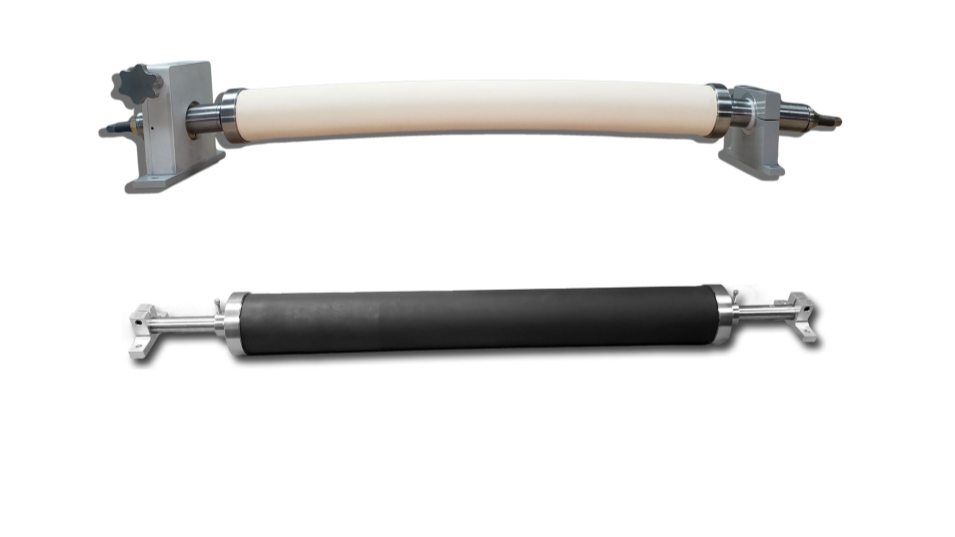
A bowed roller is manufactured exactly as the name states – the center axle of the roller is bowed (not linear). A series of internal ball bearings, supported by the axle, in turn support a rubber sleeve which is continuous across the bowed roller face. The amount of curve (bow) in the roller face is application dependent. Bowed rollers are available with both adjustable and non-adjustable bows (amount of bow).

Bowed Rollers. Tried and True Performance.
Theory of operation:
This anti-wrinkle roller works, based on two different web handling principles.
First, as we know, a web will seek to align itself perpendicular to this roller (as long as it is in traction with the roller). This causes the web to spread at any given interval across its width as it tries to maintain the 90° tangent points across the curved axis of the bowed roller face width.
Second, the rubber sleeve, which spans the roller face, is narrower on the entry side of the roller than the exit side, so as it rotates, the rubber sleeve stretches and the material, laying on top of the rubber surface, stretches with the rubber sleeve.
Because this roller normally operates best with minimal wrap angle, the operating principle does most of the work. Less surface contact between the web and the rubber sleeve means less stretching principle will affect overall wrinkle elimination. However, the spreading based on web handling principle is hardly affected by wrap angle.

How Bowed Rollers Work.
Recommended wrap angle is less than 30°; this is very important to proper bowed roller operation, do not overlook wrap angle on your bowed roller. Many times, when it appears a bowed roller is not operating properly, this is due to wrap angles to great for the application. Just as important, lead-in and lead-out distances are critical. Typical lead-in (entry span) to the curved axis (bowed) roller should be approximately double the lead-out distance (exit span). As you can see in the illustration, most of the anti-wrinkle action provided by a bowed roller is done in the entry span to the bowed roller, so the longer the entry span, the more web wrinkles will be eliminated. The exit span should be kept short so the web stays flat with no wrinkles. The longer the exit span, the more chance there is for the anti-wrinkle effect to be lost (or the web may return to its wrinkled or natural state). As you can see web geometry is critical to bowed roller application and operation.
Main advantages:
- This type of anti-wrinkle roller is aggressive at eliminating web wrinkles.
- Bowed rollers are very common. They are accepted for all facets of converting from narrow web to wide web (it is especially used in wide web applications) and slow speed to high speed.
- This type of anti-wrinkle roller is used with all types of webs in all types of converting processes.
- Bowed rollers have a smooth surface, so they will not mark or scratch the surface of the web.
Main disadvantages:
- Bowed rollers are not linear, so they can permanently distort the center of some webs. Because web tension is not evenly distributed across the face of bowed rollers, added tension delivered to the center of the web (due to curved shape of the bowed roller) may cause this permanent distortion.
- When maintenance is required, bowed rollers are normally returned to the roller manufacturer.
- Because the rubber sleeve is dynamic (it constantly stretches and contracts with each revolution) the rubber sleeve wears over time.
Expanding Surface Anti-Wrinkle Roller
Description:
This type of anti-wrinkle roller is manufactured with a rubber sleeve stretched across its face. On each end of the rubber sleeve there are end collars that clamp and hold the sleeve in place. The end collars are mounted on bearings and an adjustable axle. The sleeve is mounted across a series of flexible rubber disks. The rubber sleeve and end caps rotate together.

No-Bow, No-Grooves. Perfect Anti-Wrinkle Action for Your Web.
Theory of operation:
This roller must be incorporated as a dead shaft idler roller, in order to operate properly. The continuous rubber sleeve is pre-loaded across the face of the roller. The end collars are clamped on to each end of the rubber sleeve. The end collars are then canted with an adjustment screw and flange-axle assembly. The canting adjustment is designed so that the collars are facing each other on one side of the roller face and they are away from each other on the opposite (180°) side of the roller. The continuous rubber sleeve stretches from the point where the collars are facing each other, to where the collars are away from each other. The sleeve then contracts for the next 180° of rotation, from where the end collars are facing away from each other to where they are facing toward each other. Bottom line, the rubber sleeve physically stretches from the short side of the rubber sleeve to the long side of the rubber sleeve, then contracts again. The web enters the contracted side of the rubber sleeve and exits on the expanded side. As this roller rotates, the stretching action of the rubber sleeve eliminates wrinkles from the web.

How Expanding Surface Anti-Wrinkle Rollers Work.
Recommended wrap angle for this roller is from 90° to 180°. More wrap (up to 180° maximum) means more wrinkle removal. The amount of web spreading is directly proportional to the amount of wrap angle. In other words 180° of wrap will provide for 100% of possible spreading, 90° of wrap will provide 50% of possible spreading, 45° of wrap will provide 25% of possible spreading, etc. Lead-in and lead-out distances are not critical in the application of this type of anti-wrinkle device, because all or most of the web spreading is taking place on the roller face, not in the entry span to the roller.
Main advantages:
- This type of anti-wrinkle system is an aggressive wrinkle eliminating device.
- Anti-wrinkle aggression is adjustable from 0% (idler roller) to 100%. Adjustment can be made while the web is running with standard tools. Each side of the roller is independently adjustable.
- This roller is linear across its face, so tension remains evenly distributed across the roller face. This roller will not, cannot, distort your web.
- Roller surface is smooth and linear so it will not mark, scratch or deform a web.
- This roller is used with all types of webs, paper, film foil, textile or nonwoven. In all type of web converting machines. Narrow web to wide web, slow speed to high. Ultra thin (less than .0005") webs run perfectly.
Main disadvantages:
- Web speeds are a consideration when utilizing this roller. If the web speed causes the sleeve to balloon, as a result of centrifugal force, then the roller may not operate properly.
Performance!
At the end of the day, it all comes down to performance. The converting industry constantly evolves. Thinner materials are more common. Faster running speeds are always desired. Many machine and inherent material properties will cause web wrinkles, slowing your throughput.
Anti-wrinkle system and roller technology must strive to stay current with converters needs. Anti-wrinkle rollers must eliminate web wrinkles with little or no web distortion!

Premier Anti-Wrinkle System
CAC and WrinkleSTOP are Double E Group brands.
Web Handling 101 newsletter brought to you by the web handling experts at Double E Group. We provide the technology, engineering and equipment you need for web handling in your converting process. Contact us today to learn more and receive a proposal.
www.ee-co.com
To learn more about anti-wrinkle systems for paper, film, foil, textile and nonwoven converting applications.
https://www.ee-co.com/products/cg/wrinklestop-no-bow-spreader-roller/
News No. 104
|


 Register Here
 Please wait